





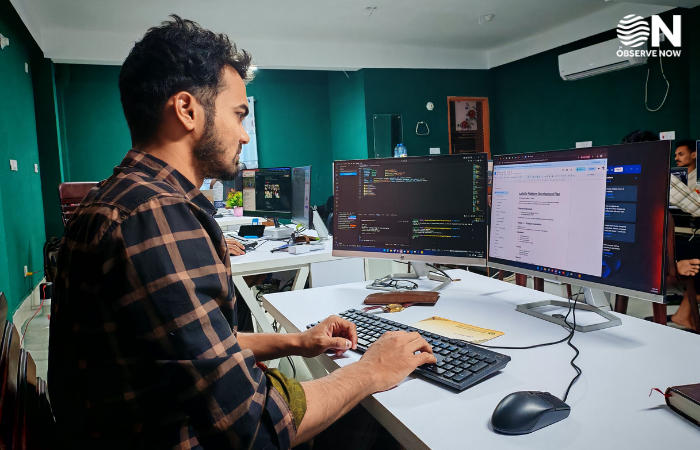
The most dangerous part of a developer’s laptop is not what’s stored on it. It’s what the laptop can reach.
That is the lesson of the TraderTraitor campaign. An Indian IT services provider was compromised after TraderTraitor, a financially motivated, DPRK state-sponsored Lazarus subgroup, took over a DevOps engineer’s MacBook. The machine had access to cloud environments and source-control systems, which gave the attackers a valuable foothold inside the organisation.
For Indian businesses, the incident is a close fit. IT services firms and large enterprises rely on DevOps teams to run cloud infrastructure, automate deployments and maintain software environments. In these organisations, a developer workstation can reach far more than the data on its own disk.
Why the Developer Endpoint Matters
The compromised engineer routinely used Terraform and Ansible with AWS, OVH and OpenStack, and the MacBook held cloud credentials and source-control access.
An attacker who compromises an ordinary employee workstation is typically after corporate data, credentials or internal applications. A compromised DevOps workstation offers something more: a route to the infrastructure itself, including cloud environments, infrastructure-as-code repositories and development systems.
TraderTraitor exploited exactly this relationship. Rather than attacking the cloud environment head-on, the attackers went after the person who could legitimately access it.
How the Attackers Got In
The campaign used fake job interviews and coding assignments. The attackers built GitHub repositories that looked like genuine infrastructure engineering exercises.
Several contained a malicious .terraform.lock.hcl file pointing to attacker-controlled provider domains. When the victim ran terraform init, Terraform downloaded and executed the malicious provider modules.
Nothing about this looked unusual. Running Terraform on an infrastructure project is routine work. The risk lay in the origin of the project and in what it made the development environment execute.
SentinelOne researchers found the FLATROOF and ROOFDECK backdoors on the Indian victim’s Mac. Between them, they enabled command execution, file operations, data collection and exfiltration. The attackers stayed active on the machine while the developer carried on working, including cloning another Terraform repository.
Should Developer Machines Be Treated as Privileged Infrastructure?
This is the question the incident puts to CISOs, and for organisations where developers have direct access to cloud platforms and code repositories, the answer is increasingly yes.
A developer endpoint sits between three critical layers: the employee, the development environment and production infrastructure. Compromise it, and attackers may not need to defeat cloud security controls at all. They can simply use the credentials and tools the employee already has. Identity, endpoint and cloud security can no longer be managed as separate problems.
The human factor also matters. A request to complete a coding assignment or review a GitHub repository can feel unrelated to an employee’s day job. But on a company-managed machine, that activity brings external code into an environment with access to corporate systems.
The Supply-Chain Risk Now Extends to Developers
Software supply-chain security has traditionally centred on the third-party applications, packages and dependencies an organisation uses. TraderTraitor points to another exposure: the projects developers download and run themselves. Terraform providers, GitHub repositories and development tools can all become links in an attack chain.
Supply-chain controls, then, cannot stop at production applications. Organisations also need visibility into what developers download, execute and connect to from corporate endpoints.
What to Change
Indian enterprises can use this incident to reassess the privileges attached to developer machines:
- Identify high-risk developers. Map who has access to cloud infrastructure, source control and other sensitive environments, and apply stronger endpoint monitoring to their devices.
- Hunt for warning signs. Watch for unsigned binaries running from user directories, unusual processes spawned by development tools, and suspicious outbound connections from those processes.
- Set clear developer policies. Train employees on the risks of running unsolicited repositories and coding assignments on corporate machines.
- Rethink interviews. Consider whether external job interviews and coding exercises should ever take place on company-managed devices.

CISONow.in is ObserveNow Media's editorial property built for Chief Information Security Officers and the security leaders around them.