




Traditional botnet takedowns and static IP blocklists no longer offer sufficient protection for enterprise networks. Research from Black Lotus Labs, the threat intelligence arm of Lumen Technologies, has exposed “Silent Train,” a disciplined operational framework used by Chinese state-sponsored threat group Volt Typhoon to maintain stealth access across critical infrastructure ecosystems.
Nation-state actors are actively bypassing perimeter defenses by exploiting broad-reach administrative platforms, routinely burning valuable zero-day vulnerabilities simply to establish short-lived relay nodes.
From Static Botnets to Disposable Chains
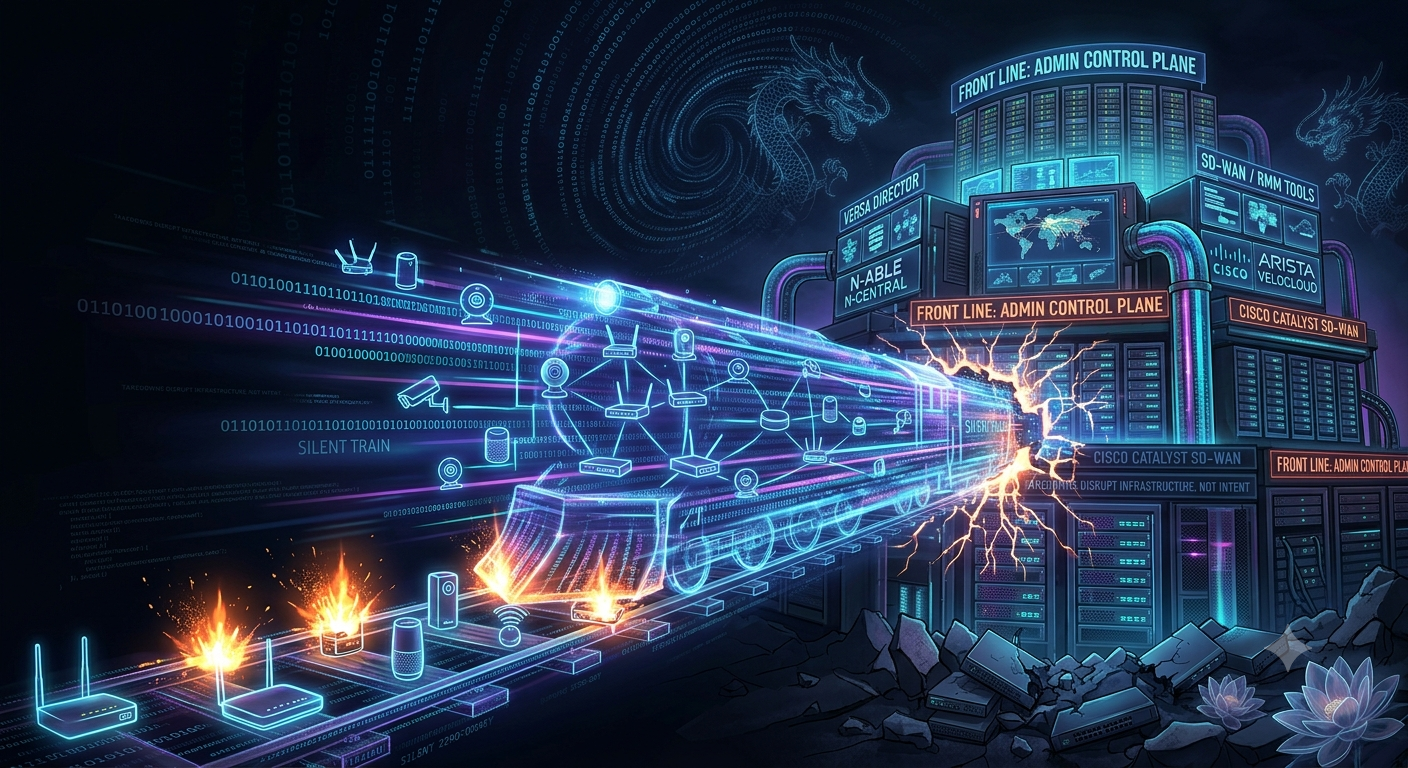
Following the late-2023 law enforcement disruption of Volt Typhoon’s KV-botnet, the group abandoned persistent proxy networks in favor of transient, disposable chains of compromised devices. Operators rapidly assemble, utilize, scrub, and discard these nodes on demand.
-
Multi-Hop Chaining: Malicious traffic routes through an average of four to six intermediary hops.
-
Layered Attack Path: Connections originate from temporary non-U.S. Virtual Private Servers (VPS), transit through compromised international SOHO and IoT devices, and exit through compromised U.S. consumer routers.
-
Evasion by Design: Domestic exit nodes allow attack traffic to blend seamlessly into normal U.S. internet activity, effortlessly bypassing geofencing controls and IP reputation blocklists.
Targeting the Control Plane
Lumen’s three-year investigation into Silent Train led to hundreds of victim notifications across vital sectors, including:
-
Critical infrastructure, telecommunications, and satellite communications
-
Government networks, defense contractors, and military-linked higher education institutions
-
Geographic clustering in Hawaii, California, and Texas—regions pivotal to U.S. Indo-Pacific logistics and military readiness.
Rather than attacking individual endpoints, Volt Typhoon systematically targets administrative control planes:
-
SD-WAN Orchestrators: Cisco Catalyst SD-WAN and Arista VeloCloud
-
Endpoint & Network Management Platforms: N-able N-central and Versa Director
-
Out-of-Band Management Consoles
Compromising a single centralized platform grants attackers deep visibility and administrative reach across an entire enterprise and its downstream customer networks without triggering noisy lateral movement alarms.
Operational Discipline and Anti-Forensics
Volt Typhoon enforces strict operational hygiene to prevent detection and attribution:
-
Ephemeral Sessions: Operational access windows average roughly four hours, with many lasting only minutes.
-
Artifact Cleanup: Operators deploy lightweight, temporary tooling and “live off the land” utilities, thoroughly wiping logs, keys, and artifacts upon session completion.
-
Zero-Day Resource Commitment: Researchers observed the group using zero-day exploits on single, disposable relay devices within a chain—underscoring the extraordinary nation-state resources committed to preserving stealth capabilities.
What CISOs Should Do Now
Centralized administrative systems have become primary targets for nation-state pre-positioning operations. Security leaders should prioritize the following defensive steps:
-
Reduce External Exposure: Eliminate public internet access to administrative interfaces, orchestrators, and out-of-band management consoles unless protected by strict compensating controls.
-
Defend the Control Plane: Classify SD-WAN orchestrators and Remote Monitoring and Management (RMM) tools as crown-jewel assets, applying strict zero-trust access controls and multi-factor authentication.
-
Accelerate Vulnerability Patching: Establish priority patch cycles for centralized administrative infrastructure and edge devices.
-
Invest in Telemetry & Logging: Centralize network, endpoint, and identity logs with extended retention periods to detect transient connection spikes and anomalous privileged activity.
Infrastructure takedowns disrupt threat actor operations, but they do not eliminate intent. Enterprise defenders must operate under the assumption that the next covert relay chain is already active.