




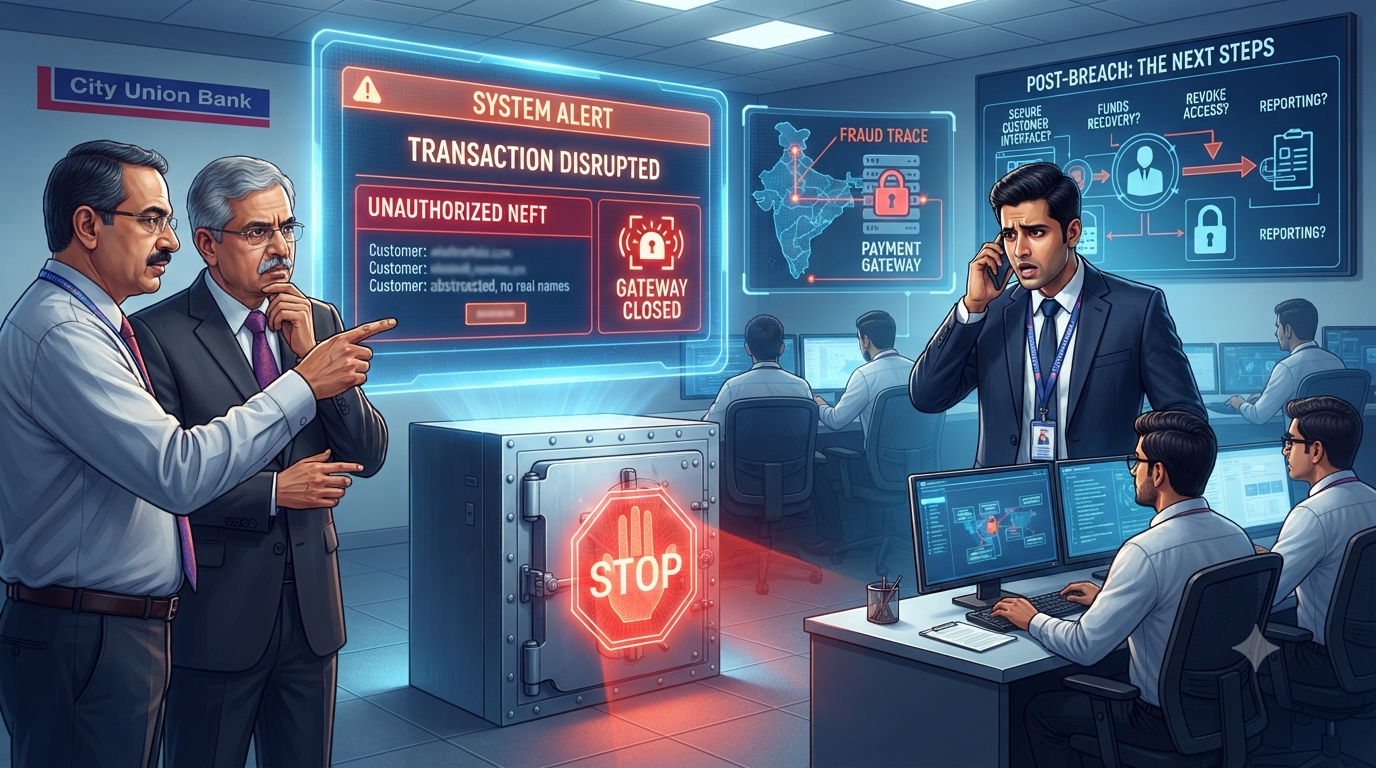
City Union Bank has shut down the payment gateways tied to one customer account after detecting an unauthorised NEFT transaction. That is a sensible first move, but it leaves a harder question open for India’s banks: what should happen after the gateway is closed?
What the bank has said
In a regulatory filing dated November 18, 2026, City Union Bank said it detected an unauthorised NEFT transaction on November 16. It has started an investigation, brought in external experts and shut down the NEFT and RTGS gateways for the affected customer’s account.
The bank said the incident had no material impact on its core business operations, financial performance or business continuity, and that core banking functions continued normally.
Containment is not the same as resolution
Isolating the gateways can stop further unauthorised transactions while investigators work. But it doesn’t establish how the transaction happened, whether other systems or accounts were exposed, or whether the underlying weakness has been fixed.
Raja Ukil, Senior Vice President and Head of Sales for APJ at ColorTokens, told CISONow that organisations must rethink their reliance on detection and response as attackers use AI to find vulnerabilities and execute attacks at machine speed.
“An isolated incident on one system is a small security event, but if it spreads across the environment, it becomes a crisis,” Ukil said. His prescription: “Traditionally, security was all detection and response. Now, because we cannot detect and respond within the timeframe of a machine-speed attack, we must pivot back into preventive security controls.”
For banks, that means a compromise of one customer account or payment channel must not give an attacker a route to other critical systems. It also means reviewing identity controls, payment authorisation, network segmentation and the ability to isolate affected systems without disrupting essential banking services.
What the filing doesn’t tell us
The disclosure is thin. It doesn’t give the transaction amount, the destination account, whether the funds were recovered or how the transaction was initiated.
It also doesn’t say whether investigators have found a compromise involving customer credentials, payment authorisation controls, internal systems, employee access or a third-party provider. Nor does it say whether other accounts have been checked for similar activity, whether the exposure is wider, or when the gateways will be restored.
Some of this may rightly stay confidential during an active investigation. The bank shouldn’t disclose customer identities or exploitable technical details. But it can still update the public on the scope of the incident, customer protection measures and the progress of its response.
Six things the bank should do next
- Establish the transaction trail. Reconstruct the full lifecycle, from initiation and authentication through authorisation, processing and settlement. Examine transaction logs, authentication records, access histories, system configurations and any changes to beneficiary details or transaction limits. The aim is to determine whether the transaction bypassed controls, used compromised credentials or exploited another weakness in the payment process.
- Test whether the exposure goes beyond one account. Review related accounts, payment channels, privileged access and connected systems for similar activity, and check whether a third-party provider or technology integration played a part. A single unauthorised transaction doesn’t automatically mean a wider compromise, but the bank should prove the incident is isolated rather than assume it.
- Trace the funds and keep the customer informed. Work with the beneficiary bank and other payment-system participants to trace the money and start recovery or freezing procedures where possible. Keep the affected customer updated on the investigation, the status of the disputed transaction and the grievance-redressal process.
- Review payment security controls. Did fraud detection flag unusual behaviour? Did authentication work as intended? Were transaction limits and beneficiary controls adequate? The bank should also test whether risk-based monitoring, velocity checks, anomaly detection and stronger authorisation for high-risk transactions would reduce the chance of a repeat.
- Preserve evidence and meet reporting obligations. Retain logs, system images, transaction records and forensic evidence. Assess reporting duties to the Reserve Bank of India and CERT-In based on the incident’s nature and classification. CERT-In’s directions require specified reportable incidents to be reported within six hours of noticing them or being notified. If all the information isn’t yet available, entities can submit what they have and follow up later.
- Restore services only after security validation. A passing threat is not a reason to reopen the gateways. The bank should validate the affected systems, close identified gaps, test transaction controls and put enhanced monitoring in place before restoring access.
The regulatory and customer dimension
The RBI’s 2025 Commercial Banks – Responsible Business Conduct Directions require banks to maintain systems that protect electronic transactions, run robust and dynamic fraud-detection mechanisms, and assess and mitigate the risks of unauthorised transactions. Banks must also give customers accessible channels to report unauthorised transactions and act immediately to prevent further activity once a complaint is received.
Importantly, the RBI places the burden of proving customer liability on the bank, and the directions set timelines for provisional credit and complaint resolution, subject to the applicable conditions.
That makes customer communication and grievance handling a core part of incident response, not an administrative task for after the forensic work is done.
What the next disclosure must answer
City Union Bank’s first filing shows it detected the transaction and moved to contain it. The next update should show how far the investigation has got, how wide the exposure is, whether the funds have been recovered and what corrective measures are being put in place.
The bank needn’t publish sensitive forensic detail while the investigation is live. But customers, investors and the wider banking ecosystem need assurance that the incident has been properly investigated and that the lessons have become stronger controls.
For CISOs across the sector, the lesson is plain: an unauthorised payment is more than a transaction dispute. It tests identity security, payment authorisation, fraud monitoring, incident response and customer protection all at once.
Shutting a gateway contains an incident. Showing how it happened, protecting customers and preventing a repeat is what demonstrates resilience.

Nair is a seasoned cybersecurity journalist with over a decade of experience covering cybersecurity and OT developments in the US and the Asia-Pacific region. As an editor, he has interviewed key decision-makers, including CISOs, CIOs, regulators and law enforcement leaders. Before joining ObserveNow, Nair held editorial roles at Information Security Media Group, News Corp owned TechCircle, IDG, The Times Group and The New Indian Express. He is currently based in Bilaspur, India.